Introduction
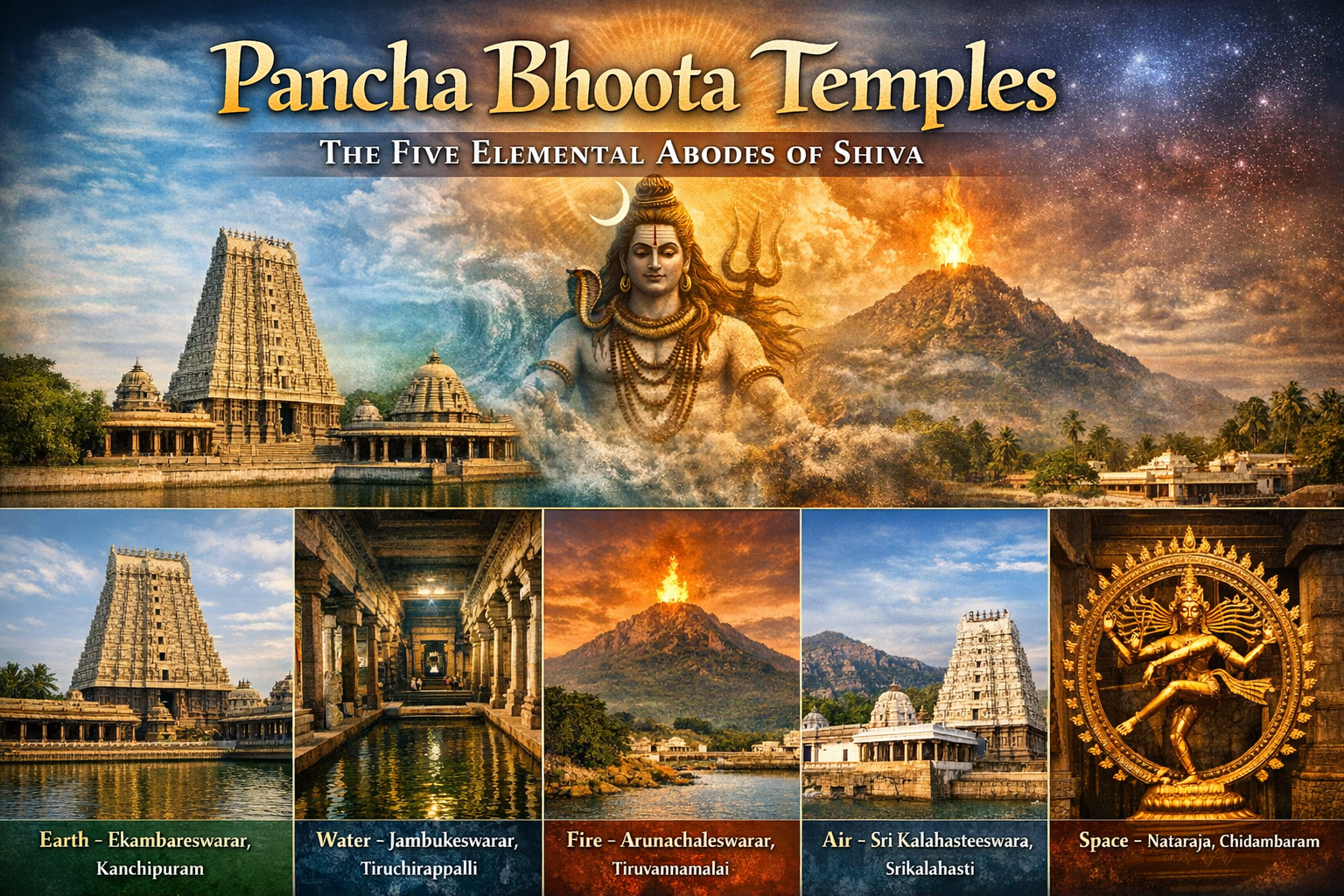
In Hindu philosophy, the entire universe is composed of five fundamental elements — earth, water, fire, air, and space, collectively known as the Pancha Bhootas. These elements are not merely physical substances but represent cosmic principles that sustain life and consciousness.
Across South India, five ancient temples dedicated to Shiva embody these elements in their purest spiritual form. Known as the Pancha Bhoota Sthalams, these temples are revered as living centers where nature and divinity converge.
The Five Panch Bhoota Temples
| Element | Temple | Location | Deity |
|---|---|---|---|
| Earth (Prithvi) | Ekambareswarar Temple | Kanchipuram | Ekambareswarar |
| Water (Apas) | Jambukeswarar Temple | Srirangam (Trichy) | Jambukeswarar |
| Fire (Agni) | Arunachaleswarar Temple | Tiruvannamalai | Arunachaleswarar |
| Air (Vayu) | Sri Kalahasteeswara Temple | Srikalahasti | Kalahasteeswara |
| Space (Akasha) | Chidambaram Nataraja Temple | Chidambaram | Nataraja |
Significance of Each Element
🌍 Earth Element
Ekambareswarar Temple
Historical Background
- One of the oldest temples in Kanchipuram, dating back over 1,500 years
- Expanded during the Pallava Dynasty and later by the Chola Dynasty
- Features a towering gopuram (~59 meters) built by the Vijayanagara rulers
Legend
According to tradition, Parvati performed penance here to marry Shiva:
- She created a lingam from sand (earth element) under a mango tree
- When the river threatened to wash it away, she embraced it to protect it
- Shiva, moved by her devotion, accepted her as his consort
Unique Features
- Ancient 3,500-year-old mango tree with four different types of mangoes
- Lingam made of earth — not bathed with water, but only decorated
💧 Water Element
Jambukeswarar Temple
Historical Background
- Built by early Chola Dynasty rulers
- Located on the island of Srirangam
Legend
- Goddess Parvati, as Akilandeswari, performed penance under a jambu (rose apple) tree
- She fashioned a lingam from water and worshipped Shiva
- Shiva appeared and imparted spiritual knowledge
Unique Features
- The sanctum has a natural underground water spring
- Water constantly seeps and surrounds the lingam
- Midday ritual: priest performs पूजा dressed as a female, symbolizing Parvati
🔥 Fire Element
Arunachaleswarar Temple
Historical Background
- Associated with Lingodbhava, the infinite pillar of fire
- Temple expanded by Chola Dynasty and Vijayanagara Empire
Legend
A famous story involving:
- Brahma and Vishnu arguing over supremacy
- Shiva appeared as an endless column of fire
- Both failed to find its beginning or end
- This established Shiva as the infinite cosmic force
Unique Features
- The entire Arunachala hill is considered Shiva himself
- Girivalam (circumambulation) of the hill is highly sacred
- Karthigai Deepam festival — massive flame lit atop the hill visible for miles
🌬️ Air Element
Sri Kalahasteeswara Temple
Historical Background
- Temple dates back to the 5th century CE
- Patronized by Chola Dynasty and Vijayanagara Empire
Legend
Named after three devotees:
- Sri (Spider)
- Kala (Serpent)
- Hasti (Elephant)
Each worshipped Shiva in their own way and attained liberation.
Another famous legend:
- Devotee Kannappa Nayanar offered his own eyes to Shiva
- Shiva stopped him and granted salvation
Unique Features
- A lamp inside the sanctum flickers without airflow, symbolizing air element
- Famous for Rahu-Ketu dosha rituals
🌌 Space Element
Chidambaram Nataraja Temple
Historical Background
- One of the most important temples of Shaivism
- Associated with cosmic dance of Shiva (Nataraja)
- Developed under Chola Dynasty
Legend
- Shiva performed the Ananda Tandava (Cosmic Dance) here
- The sages of the Daruka forest challenged Shiva, but he defeated their illusions
- The dance symbolizes creation, preservation, and destruction
Chidambara Rahasyam (Sacred Secret)
- Behind the curtain lies empty space, worshipped as divine
- Represents the formless, infinite consciousness
Unique Features
Represents Akasha (space) — the subtlest element
Only temple where Shiva is worshipped in human form (Nataraja)
Combines dance, philosophy, and spirituality
Spiritual Importance
The Panch Bhoota temples are not just places of worship but represent:
- The unity of nature and spirituality
- The human body as a microcosm of the universe
- The journey from material existence to cosmic realization
Pilgrims believe that visiting all five temples helps in:
- Balancing inner energies
- Spiritual purification
- Attaining higher awareness
Pilgrimage Route (Travel Circuit)
🗺️ Ideal Route (Starting from Chennai)
Day 1 — Kanchipuram
- Visit Ekambareswarar Temple
- Distance from Chennai: ~75 km
Darshan Timings:
- Morning: 6:00 AM – 12:30 PM
- Evening: 4:00 PM – 8:30 PM
📌 Important Notes:
- Mondays and Pradosham days are crowded
- Traditional attire is recommended
- Special pujas available inside the complex
Day 2 — Tiruvannamalai
- Visit Arunachaleswarar Temple
- Distance: ~115 km from Kanchipuram
🕒 Darshan Timings:
- Morning: 5:30 AM – 12:30 PM
- Evening: 3:30 PM – 9:30 PM
📌 Special Experience:
- Girivalam (circumambulation of Arunachala hill) — 14 km sacred walk
📌 Tips:
- Best done during full moon nights
- Carry water and comfortable footwear
Day 3 — Chidambaram
- Visit Nataraja Temple
- Distance: ~150 km
🕒 Darshan Timings:
- Morning: 6:00 AM – 12:00 PM
- Evening: 5:00 PM – 10:00 PM
📌 Unique Feature:
- Chidambara Rahasyam (worship of empty space)
📌 Tips:
- Check timing for special “Aarti” rituals
- Dress modestly (strict in inner areas)
Day 4 — Tiruchirappalli
- Visit Jambukeswarar Temple
- Distance: ~170 km
🕒 Darshan Timings:
- Morning: 6:00 AM – 1:00 PM
- Evening: 3:00 PM – 8:00 PM
📌 Unique Ritual:
- Midday पूजा where a priest performs rituals dressed as Goddess Parvati
📌 Tips:
- Carry light clothing (humid environment)
- Respect silence in inner sanctum
Day 5 — Srikalahasti
- Visit Kalahasteeswara Temple
- Distance: ~250 km
🕒 Darshan Timings:
- Morning: 6:00 AM – 9:00 PM (continuous)
📌 Special Ritual:
- Rahu–Ketu dosha puja (very popular)
📌 Important:
- Entry restrictions during certain rituals
- Follow temple queue system strictly
Total Route Highlights
- Covers Tamil Nadu + Andhra Pradesh
- Approx. 700–800 km circuit
- Best done in 5–7 days
🗺️ Interactive Route Map for Pancha Bhoota Temples
Planning your pilgrimage across the five elemental abodes of Lord Shiva becomes much easier with an interactive route map. This map connects all five sacred temples in a practical travel sequence, helping devotees visualize the journey and plan efficiently.
👉 Open the full pilgrimage route on Google Maps
🚗 Travel Tip
This route is arranged to minimize backtracking and can typically be covered in 5–7 days, depending on your pace and time spent at each temple.
For the best experience:
- Start early each day
- Plan overnight stays near major temple towns
- Avoid peak festival rush unless you want a cultural deep-dive
Best Time to Visit
- November to February — pleasant weather
- Festival highlights:
- Karthigai Deepam (Tiruvannamalai)
- Arudra Darshan (Chidambaram)
- Maha Shivaratri (all temples)
Architectural Highlights
These temples showcase:
- Massive Dravidian gopurams
- Intricate stone carvings
- Sacred temple tanks
- Unique sanctum designs reflecting elements
Unique Ritual Traditions
- Chidambaram: Worship of empty space (formless divine)
- Jambukeswarar: Priest performs rituals dressed as a woman (symbolizing Parvati)
- Tiruvannamalai: Girivalam (circumambulation of the hill)
- Srikalahasti: Special rituals for Rahu-Ketu dosha
Deeper Symbolism
The Panch Bhootas correspond to:
| Element | Human Connection |
|---|---|
| Earth | Body |
| Water | Fluids |
| Fire | Metabolism |
| Air | Breath |
| Space | Consciousness |
Thus, visiting these temples is symbolic of aligning the body, mind, and soul with the cosmos.
Conclusion
The Panch Bhoota temples represent one of the most profound spiritual concepts in Hinduism — the realization that the divine exists in every element of creation.
A journey through these temples is not just a pilgrimage across geography, but a journey through the very building blocks of existence.
Related Posts
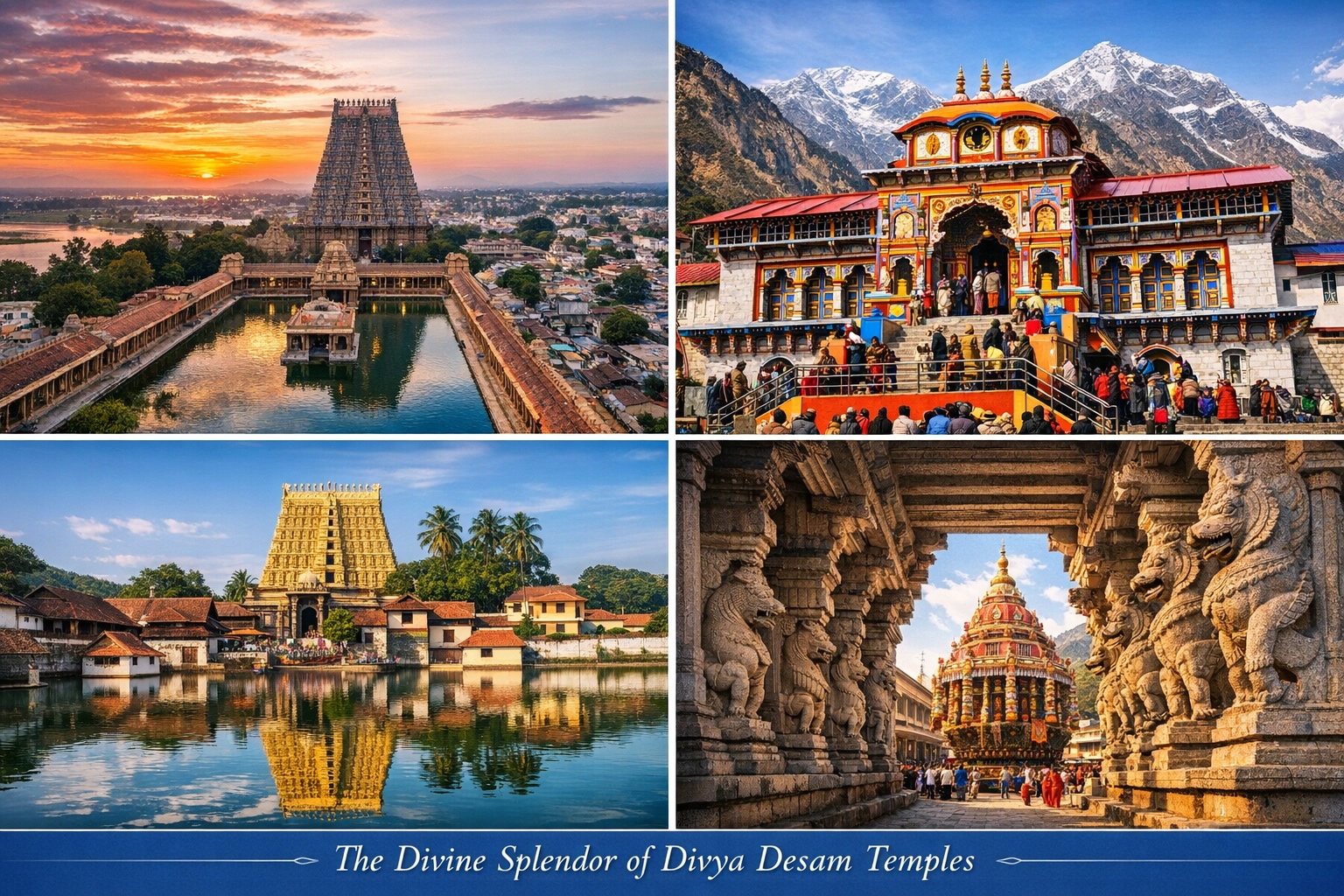
Divya Desams: The 108 Sacred Abodes of Vishnu in the Sri Vaishnava Tradition
Facebook Share on X LinkedIn WhatsApp Email Copy Link Introduction Among the most sacred pilgrimage [...]
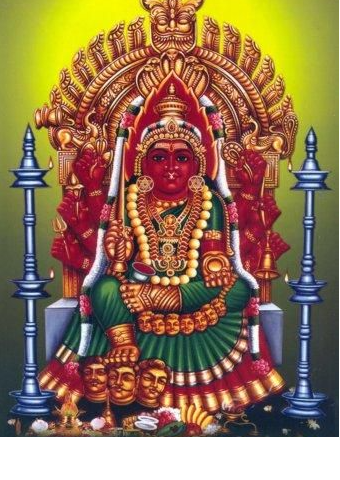
Mariamman: The Mother Goddess of Rain, Healing, and Protection
Facebook Share on X LinkedIn WhatsApp Email Copy Link Introduction Across the villages, towns, and [...]