The Chausath Yogini tradition represents one of the most esoteric streams of Tantric Shaktism. Each Yogini embodies a distinct current of Shakti expressed through iconography, sacred symbolism, ritual benefits, and invocation mantras. This consolidated reference is designed for publication and combines artistic, theological, and ritual perspectives into a unified format suitable for researchers, spiritual readers, and heritage enthusiasts.
Traditional Tantric practice invokes each Yogini through bija-infused mantras, visual meditation (dhyana), and ritual offerings aligned with her elemental and symbolic attributes.
Iconography • Powers • Mantras
| No. | Yogini Name | Iconography (Summary) | Symbolism & Powers | Ritual Benefits | Invocation Mantra |
|---|---|---|---|---|---|
| 1 | Maya (Bahurupa) | Depicted in dynamic tantric posture with symbolic attributes and vahana; regional sculptural variations. | Embodies a distinct current of Shakti governing protection, transformation, knowledge, and esoteric energy. | Worship believed to grant protection, obstacle removal, spiritual empowerment, and siddhi attainment. | Om Maya Bahurupayai Namah |
| 2 | Tara | Depicted in dynamic tantric posture with symbolic attributes and vahana; regional sculptural variations. | Embodies a distinct current of Shakti governing protection, transformation, knowledge, and esoteric energy. | Worship believed to grant protection, obstacle removal, spiritual empowerment, and siddhi attainment. | Om Tarayai Namah |
| 3 | Narmada | Depicted in dynamic tantric posture with symbolic attributes and vahana; regional sculptural variations. | Embodies a distinct current of Shakti governing protection, transformation, knowledge, and esoteric energy. | Worship believed to grant protection, obstacle removal, spiritual empowerment, and siddhi attainment. | Om Narmadayai Namah |
| 4 | Yamuna | Depicted in dynamic tantric posture with symbolic attributes and vahana; regional sculptural variations. | Embodies a distinct current of Shakti governing protection, transformation, knowledge, and esoteric energy. | Worship believed to grant protection, obstacle removal, spiritual empowerment, and siddhi attainment. | Om Yamunayai Namah |
| 5 | Shanti | Depicted in dynamic tantric posture with symbolic attributes and vahana; regional sculptural variations. | Embodies a distinct current of Shakti governing protection, transformation, knowledge, and esoteric energy. | Worship believed to grant protection, obstacle removal, spiritual empowerment, and siddhi attainment. | Om Shantiyai Namah |
| 6 | Varuni | Depicted in dynamic tantric posture with symbolic attributes and vahana; regional sculptural variations. | Embodies a distinct current of Shakti governing protection, transformation, knowledge, and esoteric energy. | Worship believed to grant protection, obstacle removal, spiritual empowerment, and siddhi attainment. | Om Varuniyai Namah |
| 7 | Ajita | Depicted in dynamic tantric posture with symbolic attributes and vahana; regional sculptural variations. | Embodies a distinct current of Shakti governing protection, transformation, knowledge, and esoteric energy. | Worship believed to grant protection, obstacle removal, spiritual empowerment, and siddhi attainment. | Om Ajitayai Namah |
| 8 | Charchika | Depicted in dynamic tantric posture with symbolic attributes and vahana; regional sculptural variations. | Embodies a distinct current of Shakti governing protection, transformation, knowledge, and esoteric energy. | Worship believed to grant protection, obstacle removal, spiritual empowerment, and siddhi attainment. | Om Charchikayai Namah |
| 9 | Marjari (Betali) | Depicted in dynamic tantric posture with symbolic attributes and vahana; regional sculptural variations. | Embodies a distinct current of Shakti governing protection, transformation, knowledge, and esoteric energy. | Worship believed to grant protection, obstacle removal, spiritual empowerment, and siddhi attainment. | Om Marjari Betaliyai Namah |
| 10 | Chinnamastaka | Depicted in dynamic tantric posture with symbolic attributes and vahana; regional sculptural variations. | Embodies a distinct current of Shakti governing protection, transformation, knowledge, and esoteric energy. | Worship believed to grant protection, obstacle removal, spiritual empowerment, and siddhi attainment. | Om Chinnamastakayai Namah |
| 11 | Vrisabhanana | Depicted in dynamic tantric posture with symbolic attributes and vahana; regional sculptural variations. | Embodies a distinct current of Shakti governing protection, transformation, knowledge, and esoteric energy. | Worship believed to grant protection, obstacle removal, spiritual empowerment, and siddhi attainment. | Om Vrisabhananayai Namah |
| 12 | Maheswari | Depicted in dynamic tantric posture with symbolic attributes and vahana; regional sculptural variations. | Embodies a distinct current of Shakti governing protection, transformation, knowledge, and esoteric energy. | Worship believed to grant protection, obstacle removal, spiritual empowerment, and siddhi attainment. | Om Maheswariyai Namah |
| 13 | Kamakshi-Ambika | Depicted in dynamic tantric posture with symbolic attributes and vahana; regional sculptural variations. | Embodies a distinct current of Shakti governing protection, transformation, knowledge, and esoteric energy. | Worship believed to grant protection, obstacle removal, spiritual empowerment, and siddhi attainment. | Om Kamakshi Ambikayai Namah |
| 14 | Kamayani | Depicted in dynamic tantric posture with symbolic attributes and vahana; regional sculptural variations. | Embodies a distinct current of Shakti governing protection, transformation, knowledge, and esoteric energy. | Worship believed to grant protection, obstacle removal, spiritual empowerment, and siddhi attainment. | Om Kamayaniyai Namah |
| 15 | Ghatabari | Depicted in dynamic tantric posture with symbolic attributes and vahana; regional sculptural variations. | Embodies a distinct current of Shakti governing protection, transformation, knowledge, and esoteric energy. | Worship believed to grant protection, obstacle removal, spiritual empowerment, and siddhi attainment. | Om Ghatabariyai Namah |
| 16 | Stutee | Depicted in dynamic tantric posture with symbolic attributes and vahana; regional sculptural variations. | Embodies a distinct current of Shakti governing protection, transformation, knowledge, and esoteric energy. | Worship believed to grant protection, obstacle removal, spiritual empowerment, and siddhi attainment. | Om Stuteeyai Namah |
| 17 | Kali | Depicted in dynamic tantric posture with symbolic attributes and vahana; regional sculptural variations. | Embodies a distinct current of Shakti governing protection, transformation, knowledge, and esoteric energy. | Worship believed to grant protection, obstacle removal, spiritual empowerment, and siddhi attainment. | Om Kaliyai Namah |
| 18 | Uma | Depicted in dynamic tantric posture with symbolic attributes and vahana; regional sculptural variations. | Embodies a distinct current of Shakti governing protection, transformation, knowledge, and esoteric energy. | Worship believed to grant protection, obstacle removal, spiritual empowerment, and siddhi attainment. | Om Umayai Namah |
| 19 | Narayani | Depicted in dynamic tantric posture with symbolic attributes and vahana; regional sculptural variations. | Embodies a distinct current of Shakti governing protection, transformation, knowledge, and esoteric energy. | Worship believed to grant protection, obstacle removal, spiritual empowerment, and siddhi attainment. | Om Narayaniyai Namah |
| 20 | Samudra | Depicted in dynamic tantric posture with symbolic attributes and vahana; regional sculptural variations. | Embodies a distinct current of Shakti governing protection, transformation, knowledge, and esoteric energy. | Worship believed to grant protection, obstacle removal, spiritual empowerment, and siddhi attainment. | Om Samudrayai Namah |
| 21 | Vayuvega | Depicted in dynamic tantric posture with symbolic attributes and vahana; regional sculptural variations. | Embodies a distinct current of Shakti governing protection, transformation, knowledge, and esoteric energy. | Worship believed to grant protection, obstacle removal, spiritual empowerment, and siddhi attainment. | Om Vayuvegayai Namah |
| 22 | Chamunda | Depicted in dynamic tantric posture with symbolic attributes and vahana; regional sculptural variations. | Embodies a distinct current of Shakti governing protection, transformation, knowledge, and esoteric energy. | Worship believed to grant protection, obstacle removal, spiritual empowerment, and siddhi attainment. | Om Chamundayai Namah |
| 23 | Murati | Depicted in dynamic tantric posture with symbolic attributes and vahana; regional sculptural variations. | Embodies a distinct current of Shakti governing protection, transformation, knowledge, and esoteric energy. | Worship believed to grant protection, obstacle removal, spiritual empowerment, and siddhi attainment. | Om Muratiyai Namah |
| 24 | Ganga | Depicted in dynamic tantric posture with symbolic attributes and vahana; regional sculptural variations. | Embodies a distinct current of Shakti governing protection, transformation, knowledge, and esoteric energy. | Worship believed to grant protection, obstacle removal, spiritual empowerment, and siddhi attainment. | Om Gangayai Namah |
| 25 | Dhumavati (Tarini) | Depicted in dynamic tantric posture with symbolic attributes and vahana; regional sculptural variations. | Embodies a distinct current of Shakti governing protection, transformation, knowledge, and esoteric energy. | Worship believed to grant protection, obstacle removal, spiritual empowerment, and siddhi attainment. | Om Dhumavati Tariniyai Namah |
| 26 | Gandhari | Depicted in dynamic tantric posture with symbolic attributes and vahana; regional sculptural variations. | Embodies a distinct current of Shakti governing protection, transformation, knowledge, and esoteric energy. | Worship believed to grant protection, obstacle removal, spiritual empowerment, and siddhi attainment. | Om Gandhariyai Namah |
| 27 | Sarva Mangala | Depicted in dynamic tantric posture with symbolic attributes and vahana; regional sculptural variations. | Embodies a distinct current of Shakti governing protection, transformation, knowledge, and esoteric energy. | Worship believed to grant protection, obstacle removal, spiritual empowerment, and siddhi attainment. | Om Sarva Mangalayai Namah |
| 28 | Ajita (Lion-Rider) | Depicted in dynamic tantric posture with symbolic attributes and vahana; regional sculptural variations. | Embodies a distinct current of Shakti governing protection, transformation, knowledge, and esoteric energy. | Worship believed to grant protection, obstacle removal, spiritual empowerment, and siddhi attainment. | Om Ajita Lion Rideryai Namah |
| 29 | Sur Sundari | Depicted in dynamic tantric posture with symbolic attributes and vahana; regional sculptural variations. | Embodies a distinct current of Shakti governing protection, transformation, knowledge, and esoteric energy. | Worship believed to grant protection, obstacle removal, spiritual empowerment, and siddhi attainment. | Om Sur Sundariyai Namah |
| 30 | Manohara | Depicted in dynamic tantric posture with symbolic attributes and vahana; regional sculptural variations. | Embodies a distinct current of Shakti governing protection, transformation, knowledge, and esoteric energy. | Worship believed to grant protection, obstacle removal, spiritual empowerment, and siddhi attainment. | Om Manoharayai Namah |
| 31 | Kanakavati | Depicted in dynamic tantric posture with symbolic attributes and vahana; regional sculptural variations. | Embodies a distinct current of Shakti governing protection, transformation, knowledge, and esoteric energy. | Worship believed to grant protection, obstacle removal, spiritual empowerment, and siddhi attainment. | Om Kanakavatiyai Namah |
| 32 | Kameshwari | Depicted in dynamic tantric posture with symbolic attributes and vahana; regional sculptural variations. | Embodies a distinct current of Shakti governing protection, transformation, knowledge, and esoteric energy. | Worship believed to grant protection, obstacle removal, spiritual empowerment, and siddhi attainment. | Om Kameshwariyai Namah |
| 33 | Rati Sundari | Depicted in dynamic tantric posture with symbolic attributes and vahana; regional sculptural variations. | Embodies a distinct current of Shakti governing protection, transformation, knowledge, and esoteric energy. | Worship believed to grant protection, obstacle removal, spiritual empowerment, and siddhi attainment. | Om Rati Sundariyai Namah |
| 34 | Padmini | Depicted in dynamic tantric posture with symbolic attributes and vahana; regional sculptural variations. | Embodies a distinct current of Shakti governing protection, transformation, knowledge, and esoteric energy. | Worship believed to grant protection, obstacle removal, spiritual empowerment, and siddhi attainment. | Om Padminiyai Namah |
| 35 | Natini | Depicted in dynamic tantric posture with symbolic attributes and vahana; regional sculptural variations. | Embodies a distinct current of Shakti governing protection, transformation, knowledge, and esoteric energy. | Worship believed to grant protection, obstacle removal, spiritual empowerment, and siddhi attainment. | Om Natiniyai Namah |
| 36 | Madhumati | Depicted in dynamic tantric posture with symbolic attributes and vahana; regional sculptural variations. | Embodies a distinct current of Shakti governing protection, transformation, knowledge, and esoteric energy. | Worship believed to grant protection, obstacle removal, spiritual empowerment, and siddhi attainment. | Om Madhumatiyai Namah |
| 37 | Nartini | Depicted in dynamic tantric posture with symbolic attributes and vahana; regional sculptural variations. | Embodies a distinct current of Shakti governing protection, transformation, knowledge, and esoteric energy. | Worship believed to grant protection, obstacle removal, spiritual empowerment, and siddhi attainment. | Om Nartiniyai Namah |
| 38 | Varahi | Depicted in dynamic tantric posture with symbolic attributes and vahana; regional sculptural variations. | Embodies a distinct current of Shakti governing protection, transformation, knowledge, and esoteric energy. | Worship believed to grant protection, obstacle removal, spiritual empowerment, and siddhi attainment. | Om Varahiyai Namah |
| 39 | Vaishnavi | Depicted in dynamic tantric posture with symbolic attributes and vahana; regional sculptural variations. | Embodies a distinct current of Shakti governing protection, transformation, knowledge, and esoteric energy. | Worship believed to grant protection, obstacle removal, spiritual empowerment, and siddhi attainment. | Om Vaishnaviyai Namah |
| 40 | Kaumari | Depicted in dynamic tantric posture with symbolic attributes and vahana; regional sculptural variations. | Embodies a distinct current of Shakti governing protection, transformation, knowledge, and esoteric energy. | Worship believed to grant protection, obstacle removal, spiritual empowerment, and siddhi attainment. | Om Kaumariyai Namah |
| 41 | Brahmani | Depicted in dynamic tantric posture with symbolic attributes and vahana; regional sculptural variations. | Embodies a distinct current of Shakti governing protection, transformation, knowledge, and esoteric energy. | Worship believed to grant protection, obstacle removal, spiritual empowerment, and siddhi attainment. | Om Brahmaniyai Namah |
| 42 | Indrani | Depicted in dynamic tantric posture with symbolic attributes and vahana; regional sculptural variations. | Embodies a distinct current of Shakti governing protection, transformation, knowledge, and esoteric energy. | Worship believed to grant protection, obstacle removal, spiritual empowerment, and siddhi attainment. | Om Indraniyai Namah |
| 43 | Mahalakshmi | Depicted in dynamic tantric posture with symbolic attributes and vahana; regional sculptural variations. | Embodies a distinct current of Shakti governing protection, transformation, knowledge, and esoteric energy. | Worship believed to grant protection, obstacle removal, spiritual empowerment, and siddhi attainment. | Om Mahalakshmiyai Namah |
| 44 | Narasimhi | Depicted in dynamic tantric posture with symbolic attributes and vahana; regional sculptural variations. | Embodies a distinct current of Shakti governing protection, transformation, knowledge, and esoteric energy. | Worship believed to grant protection, obstacle removal, spiritual empowerment, and siddhi attainment. | Om Narasimhiyai Namah |
| 45 | Bhairavi | Depicted in dynamic tantric posture with symbolic attributes and vahana; regional sculptural variations. | Embodies a distinct current of Shakti governing protection, transformation, knowledge, and esoteric energy. | Worship believed to grant protection, obstacle removal, spiritual empowerment, and siddhi attainment. | Om Bhairaviyai Namah |
| 46 | Durga | Depicted in dynamic tantric posture with symbolic attributes and vahana; regional sculptural variations. | Embodies a distinct current of Shakti governing protection, transformation, knowledge, and esoteric energy. | Worship believed to grant protection, obstacle removal, spiritual empowerment, and siddhi attainment. | Om Durgayai Namah |
| 47 | Tripura | Depicted in dynamic tantric posture with symbolic attributes and vahana; regional sculptural variations. | Embodies a distinct current of Shakti governing protection, transformation, knowledge, and esoteric energy. | Worship believed to grant protection, obstacle removal, spiritual empowerment, and siddhi attainment. | Om Tripurayai Namah |
| 48 | Bhuvaneshwari | Depicted in dynamic tantric posture with symbolic attributes and vahana; regional sculptural variations. | Embodies a distinct current of Shakti governing protection, transformation, knowledge, and esoteric energy. | Worship believed to grant protection, obstacle removal, spiritual empowerment, and siddhi attainment. | Om Bhuvaneshwariyai Namah |
| 49 | Bagalamukhi | Depicted in dynamic tantric posture with symbolic attributes and vahana; regional sculptural variations. | Embodies a distinct current of Shakti governing protection, transformation, knowledge, and esoteric energy. | Worship believed to grant protection, obstacle removal, spiritual empowerment, and siddhi attainment. | Om Bagalamukhiyai Namah |
| 50 | Matangi | Depicted in dynamic tantric posture with symbolic attributes and vahana; regional sculptural variations. | Embodies a distinct current of Shakti governing protection, transformation, knowledge, and esoteric energy. | Worship believed to grant protection, obstacle removal, spiritual empowerment, and siddhi attainment. | Om Matangiyai Namah |
| 51 | Kamala | Depicted in dynamic tantric posture with symbolic attributes and vahana; regional sculptural variations. | Embodies a distinct current of Shakti governing protection, transformation, knowledge, and esoteric energy. | Worship believed to grant protection, obstacle removal, spiritual empowerment, and siddhi attainment. | Om Kamalayai Namah |
| 52 | Jaya | Depicted in dynamic tantric posture with symbolic attributes and vahana; regional sculptural variations. | Embodies a distinct current of Shakti governing protection, transformation, knowledge, and esoteric energy. | Worship believed to grant protection, obstacle removal, spiritual empowerment, and siddhi attainment. | Om Jayayai Namah |
| 53 | Vijaya | Depicted in dynamic tantric posture with symbolic attributes and vahana; regional sculptural variations. | Embodies a distinct current of Shakti governing protection, transformation, knowledge, and esoteric energy. | Worship believed to grant protection, obstacle removal, spiritual empowerment, and siddhi attainment. | Om Vijayayai Namah |
| 54 | Aparajita | Depicted in dynamic tantric posture with symbolic attributes and vahana; regional sculptural variations. | Embodies a distinct current of Shakti governing protection, transformation, knowledge, and esoteric energy. | Worship believed to grant protection, obstacle removal, spiritual empowerment, and siddhi attainment. | Om Aparajitayai Namah |
| 55 | Mohini | Depicted in dynamic tantric posture with symbolic attributes and vahana; regional sculptural variations. | Embodies a distinct current of Shakti governing protection, transformation, knowledge, and esoteric energy. | Worship believed to grant protection, obstacle removal, spiritual empowerment, and siddhi attainment. | Om Mohiniyai Namah |
| 56 | Khechari | Depicted in dynamic tantric posture with symbolic attributes and vahana; regional sculptural variations. | Embodies a distinct current of Shakti governing protection, transformation, knowledge, and esoteric energy. | Worship believed to grant protection, obstacle removal, spiritual empowerment, and siddhi attainment. | Om Khechariyai Namah |
| 57 | Bhadrakali | Depicted in dynamic tantric posture with symbolic attributes and vahana; regional sculptural variations. | Embodies a distinct current of Shakti governing protection, transformation, knowledge, and esoteric energy. | Worship believed to grant protection, obstacle removal, spiritual empowerment, and siddhi attainment. | Om Bhadrakaliyai Namah |
| 58 | Rudrani | Depicted in dynamic tantric posture with symbolic attributes and vahana; regional sculptural variations. | Embodies a distinct current of Shakti governing protection, transformation, knowledge, and esoteric energy. | Worship believed to grant protection, obstacle removal, spiritual empowerment, and siddhi attainment. | Om Rudraniyai Namah |
| 59 | Shivaduti | Depicted in dynamic tantric posture with symbolic attributes and vahana; regional sculptural variations. | Embodies a distinct current of Shakti governing protection, transformation, knowledge, and esoteric energy. | Worship believed to grant protection, obstacle removal, spiritual empowerment, and siddhi attainment. | Om Shivadutiyai Namah |
| 60 | Varuni (Tantric) | Depicted in dynamic tantric posture with symbolic attributes and vahana; regional sculptural variations. | Embodies a distinct current of Shakti governing protection, transformation, knowledge, and esoteric energy. | Worship believed to grant protection, obstacle removal, spiritual empowerment, and siddhi attainment. | Om Varuni Tantricyai Namah |
| 61 | Kauberi | Depicted in dynamic tantric posture with symbolic attributes and vahana; regional sculptural variations. | Embodies a distinct current of Shakti governing protection, transformation, knowledge, and esoteric energy. | Worship believed to grant protection, obstacle removal, spiritual empowerment, and siddhi attainment. | Om Kauberiyai Namah |
| 62 | Aindri | Depicted in dynamic tantric posture with symbolic attributes and vahana; regional sculptural variations. | Embodies a distinct current of Shakti governing protection, transformation, knowledge, and esoteric energy. | Worship believed to grant protection, obstacle removal, spiritual empowerment, and siddhi attainment. | Om Aindriyai Namah |
| 63 | Tvarita | Depicted in dynamic tantric posture with symbolic attributes and vahana; regional sculptural variations. | Embodies a distinct current of Shakti governing protection, transformation, knowledge, and esoteric energy. | Worship believed to grant protection, obstacle removal, spiritual empowerment, and siddhi attainment. | Om Tvaritayai Namah |
| 64 | Kulasundari | Depicted in dynamic tantric posture with symbolic attributes and vahana; regional sculptural variations. | Embodies a distinct current of Shakti governing protection, transformation, knowledge, and esoteric energy. | Worship believed to grant protection, obstacle removal, spiritual empowerment, and siddhi attainment. | Om Kulasundariyai Namah |
Major Surviving Yogini Temples
- Hirapur Yogini Temple — Odisha
- Ranipur-Jharial Yogini Temple — Odisha
- Bhedaghat Yogini Temple — Madhya Pradesh
- Mitaoli Yogini Temple — Madhya Pradesh
- Khajuraho Yogini Temple — Madhya Pradesh
The 64 Yoginis of Hirapur: A Comprehensive Reference Guide
Historical Foundations and Modern Discovery
The Chausath Yogini Temple at Hirapur, situated in the Khurda district of Odisha, stands as a premier architectural and theological testament to the flourishing of the Shakti and Tantric cults in early medieval India. Known locally as the Mahamaya Temple, this ninth-century shrine represents a unique intersection of Brahmanical Hinduism and Vajrayana Buddhism.
Historical Context and Patronage
Origins of the temple are deeply entwined with the Bhauma-Kara dynasty, which ruled the coastal belt of Odisha (Toshala) from the 8th to the 10th centuries. Scholars attribute the temple’s construction to Queen Hiradevi (Hiramahadevi), consort of King Shantikara II, around 864 CE. The village of Hirapur—formerly Hiradeipur—is named in her honor. This era was defined by religious synthesis, as the Bhauma-Kara rulers transitioned from Mahayana Buddhism toward Shaivism and Shaktism.
| Bhauma-Kara Ruler / Period | Religious Affiliation | Key Contributions / Events |
|---|---|---|
| Kshemankaradeva (c. 736 CE) | Buddhist (Paramaupasaka) | Founder of the Bhauma Era; established regional stability. |
| Shivakaradeva I (c. 756/786 CE) | Buddhist | Expanded the kingdom into Kongoda and northern Kalinga. |
| Subhakaradeva I (c. 790-800 CE) | Buddhist / Hindu Patron | Patronized the Ratnagiri monastery; his wife commissioned the Madhavesvara temple. |
| Tribhuvana-Mahadevi I (c. 846 CE) | Vaishnavism / Shaktism | First female sovereign; reunified the kingdom after external invasions. |
| Queen Hiradevi (9th Century) | Shaktism / Tantra | Commissioned the Hirapur Chausath Yogini Temple; fostered Tantric synthesis. |
The 1953 Rediscovery
Despite its proximity to Bhubaneswar, the temple remained “oblivious” to the outside world for centuries, obscured by dense jungle and paddy fields. It was rediscovered on January 24, 1953, by Kedarnath Mahapatra of the Odisha State Museum. The site remained sequestered largely due to local supernatural apprehension; villagers feared the yoginis’ powers, with legends suggesting the site was a “vortex of energy” dangerous to the uninitiated.
Architectural Typology and Sacred Geometry
The Hirapur shrine deviates from the soaring rekha deula (curvilinear spire) of standard Kalingan architecture, opting for a compact, hypaethral design suited for esoteric Kaula and Kapalika rites.
Hypaethral Design
The temple is hypaethral (roofless), a functional necessity for Tantric worship involving the bhumandala (the five elements: fire, water, earth, air, and ether). This design facilitates the direct channeling of celestial energy and accommodates the belief that yoginis possess khechari siddhi (the power of flight).
Symbolic Morphology
- Plan: From an aerial perspective, the circular enclosure with its protruding entrance resembles a yoni-pitha, symbolizing the cosmic union of Shiva (the central altar) and Shakti (the circle).
- Dimensions: The structure is compact, measuring 25–30 feet in diameter and 8–9 feet in height.
- Construction: The foundation is laterite, while the walls are coarse sandstone. The idols are carved from fine-grained black chlorite, a material whose density allows for the high-precision carving of intricate “Kesabandha” (braided) and “Jatamukuta” (matted) hairstyles.
Ancillary Structures
- Surya Pitha: A stone platform in front of the temple where devotees offered worship to the Sun, signifying solar-lunar balance.
- Chandi Mandapa: A central square pavilion housing four Bhairavas and four additional yoginis.
- Puskarini: A temple tank (Mahamaya Puskarini) located on the southern side, used for ritual purification.
The Threshold: Guardians and the Nine Katyayanis
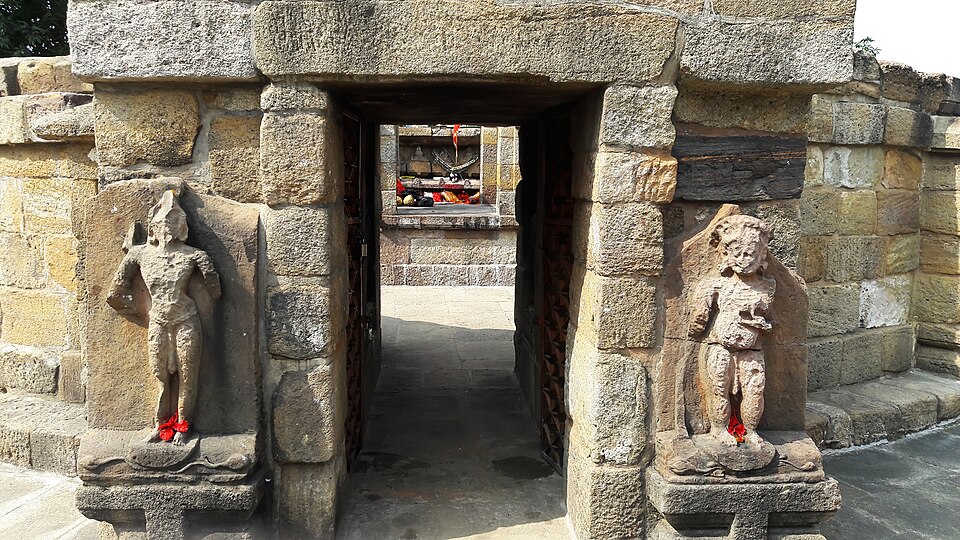
The transition into the sacred space is guarded by fierce figures designed to prompt ego-dissolution. The narrow entrance passage (4 feet long) requires visitors to stoop, an act of ritual humility.
Entrance Guardians (Dvarapalas)
- Outer Guardians: The southern gateway features a male figure with a lotus creeper; the northern guardian is wrathful and emaciated, holding a kapala (skull cup).
- Kaal and Vikaal: Located deep within the passage, these emaciated Bhairavs represent “Time” and “Death.” They feature sunken bellies, visible rib bones, and skull garlands, symbolizing the dissolution of the physical self.
The Nine External Katyayanis
Uniquely, Hirapur features nine unsmiling goddesses on the exterior wall. These sandstone figures act as a defensive ring.
- 1: A dynamic figure holding a khadga (curved sword) with two drum-beating male figures on her pedestal.
- 2: Noble figure with braided hair to the left; pedestal features a jackal and a dog with a parasol-holding attendant.
- 3: Holds a katari (dagger) and kapala; pedestal shows a jackal and a dog.
- 4: Features a female attendant feeding a dog on the pedestal; goddess carries a katari, kapala, and akshamala(beads).
- 5: Adorned with golden ornaments; pedestal features a jackal and a dog.
- 6: Holds a katari and kapala; an attendant holds a “moon crescent” over her head; two dogs appear on the pedestal.
- 7 & 8: Noble figures with katari and kapala; jackal and dog mounts.
- 9: A rare wrathful, nude figure brandishing a curved sword and kapala, standing over two jackals.
Worship Procedures and Ritual Traditions
Core Rituals
The primary worship procedure is the Chandi Path (recitation of the Devi Mahatmya). While maintained by the Archaeological Survey of India (ASI), the temple remains an active center for Shakti worship. Daily Aarti occurs morning and evening, where Mahamaya is dressed in new garments and jewelry.
Festivals
- Chausath Yogini Mahotsava: Held Dec 23–25, featuring Orissan folk music and dance.
- Navaratri: The yoginis are adorned in new clothes to celebrate the victory over demonic forces.
The Secret Nature of Tantra
Local taboos prohibit nocturnal entry. It is believed that the yoginis gather at night and are most active in the dark (the time of female wisdom energy). Staying after dark is cautioned against to avoid the “wrath” of the dakinis.
Presiding Deity: Mahamaya (Yogini No. 31)
Located in the 31st niche directly opposite the entrance, Mahamaya is the largest statue in the sanctum.
- Iconographic Profile: Depicted with ten arms, she stands upon a full-blown lotus atop a squarish Shakti Peetha. She is adorned with a mukuta, kirita, and bejeweled girdles.
- Symbolism: She is the Grama Devati (village deity) and the source of the other sixty-three emanations.
Catalog of the 64 Yoginis: Iconography and Attributes
The following table catalogs the goddesses housed in the interior niches (1-60) and the Chandi Mandapa (61-64).
| No. | Name | Vahana (Mount) | Attributes / Posture |
|---|---|---|---|
| 1 | Maya / Bahurupa | Full-blown Lotus | 4 arms; holds sword, shield, kapala, and lotus. |
| 2 | Tara | Corpse | Kesabandha hair; two-armed, standing on a corpse. |
| 3 | Narmada | Elephant | Holds a kapala near her mouth to partake of nectar. |
| 4 | Yamuna | Tortoise | 4 arms; Jatamandala hair; leaning right. |
| 5 | Shanti / Kanti | Full-blown Lotus | Two-armed; peacock feather skirt. |
| 6 | Vriddhi / Varuni | Waves | Braided hair; stands on the ocean’s surface. |
| 7 | Ajita / Gauri | Alligator | Samabhanga pose; chignon hair. |
| 8 | Aindri / Indrani | Elephant | Pratyalidha pose; wears golden ornaments. |
| 9 | Varahi | Buffalo | Boar-faced; holds bow and skull cup. |
| 10 | Ratnavira | Serpent | Wears garland of skulls; wields a sword. |
| 11 | Vanarmukhi (Murati) | Camel | Monkey-faced; Dvibhanga posture. |
| 12 | Vaishnavi | Garuda | Female energy of Vishnu; wears Sarpa Mukuta. |
| 13 | Panchavarahi | Boar | Two-armed; smiling; Tribhanga pose. |
| 14 | Vadyaroopa | Drum | Standing on a drum; symbolizes sacred sound. |
| 15 | Charchika | Crouching Male | Emaciated form; stands on a figure with a dagger. |
| 16 | Marjari / Betali | Fish | “Cat” goddess; dominion over subconscious waters. |
| 17 | Chinnamastaka | Severed Head | 4 arms; holds a bow; slaying of the ego. |
| 18 | Vrisabhanana | Hill / Cave | Bull-faced; represents grounding energy. |
| 19 | Jalakamini | Frog | Tribhanga pose; water spirit dakini. |
| 20 | Ghatavara | Lion | Holds an elephant hide over her head. |
| 21 | Vikarali | Dog | Adjusting an anklet on her left thigh. |
| 22 | Saraswati | Big Serpent | Holds a tumuru (instrument); has a moustache. |
| 23 | Birupa | Wavy Pedestal | Dvibhanga posture; braided hair. |
| 24 | Kauveri | 7 Ratna Kalasas | Standing on seven jeweled pots on a lotus. |
| 25 | Bhalluka | Lotus Creeper | Boar-faced; holds a damaru. |
| 26 | Narasimhi | Flowers/Leaves | Lion-faced; mane-like Jatamandal hair. |
| 27 | Biraja | Lotus Bud | Graceful Dvibhanga pose. |
| 28 | Vikatanana | Pedestal | Wrathful expression; protruding lips. |
| 29 | Mohalaxmi | Full-blown Lotus | Wears Sarpamala (snake garland); holds a vajra. |
| 30 | Kaumari | Peacock | Holds akshamala and shield. |
| 31 | Mahamaya | Lotus | 10 arms; presiding deity; larger scale. |
| 32 | Rati / Usa | Archer | Wrathful; stands on an archer with a bow. |
| 33 | Karkari | Crab | Tribhanga pose; hair in Kesabandha style. |
| 34 | Sarpashya | Broken Pedestal | Snake-faced; 4 arms; Dvibhanga pose. |
| 35 | Yosha | 4-legged Cot | Elaborate Jatamukuta hair; represents vitality. |
| 36 | Aghora / Vaivasvati | Horned Goat | Wrathful; bulging eyes; stands on goat-like animal. |
| 37 | Bhadrakali | Crow | Hair like flames; carries a sword. |
| 38 | Ganeshani / Vinayaki | Donkey | Elephant-headed and pot-bellied. |
| 39 | Bindhyabalini | Rat | Pratyalidha pose; holds bow and arrow. |
| 40 | Abhaya / Veera Kumari | Scorpion | Dancing pose; upper arms raised; 4 arms. |
| 41 | Maheswari | Bull | 4 arms; Kesabandha hair; golden ornaments. |
| 42 | Kamakshi / Ambika | 2 Wheels / Mongoose | Seated in bent-knee pose; holds a damaru. |
| 43 | Kamayani | Rooster | Magnetism and desire-consciousness. |
| 44 | Ghatabari | Lion | Karanda Mukuta hair; symbol of nourishment. |
| 45 | Stutee | Turmeric Pot | Standing on a Haladi Kathua (turmeric pot). |
| 46 | Kali | Male (Shiva) | Stands on male with a third eye; holds trident. |
| 47 | Uma | Lotus Flowers | 4 arms; Jatamukuta hair; holds naga weapon. |
| 48 | Narayani | Earthen Pot | Left hand over wine keg; brandishes a sword. |
| 49 | Samudra | Conch Shell | Stands on a Shankha; represents depth. |
| 50 | Brahmani | Book | 3 faces; 4 arms; stands on a book. |
| 51 | Jwalamukhi | 8-legged Pedestal | Unusually long ears; matted hair knots. |
| 52 | Agneyi | Ram | Surrounded by an aureole of fire. |
| 53 | Aditi | Parrot | Samabhanga posture; maternal Vedic origin. |
| 54 | Chandrakanti | 4-legged Cot | Radiant lunar energy; Kesabandha hair. |
| 55 | Vayubega | Female Yak | Braided hair in chignon; swift wind energy. |
| 56 | Chamunda | Musk Deer | Skeletal body; holds lion skin and decapitated head. |
| 57 | Murati | Horned Deer | Tribhanga pose; flared flame-like hair. |
| 58 | Ganga | Makara | 4 arms; holds a naga noose and lotus. |
| 59 | Dhumavati | Duck | Holds a winnowing fan; symbolizes detachment. |
| 60 | Gandhari | Horse | Stands before a Kadamba tree; inner vision. |
| 61 | Sarva Mangala | Missing | Speculated to be at Yamuna Kuda. |
| 62 | Ajita | Stag | Fearsome; 4 arms; flame-like hair. |
| 63 | Surya Putri | Galloping Horse | 4 arms; plucking an arrow from a quiver. |
| 64 | Vayu Veena | Black Buck | Associated with air; holds a veena; wears Kapa. |
Theriomorphic Analysis
Hirapur is renowned for its animal-headed yoginis, which link them to ancient tribal nature spirits. These include Varahi (Boar), Ganeshani (Elephant), Murati (Monkey), Narasimhi (Lion), and Vrisabhanana (Bull).
The Central Altar: Chandi Mandapa and the Bhairavas
The Chandi Mandapa represents the union of static consciousness and dynamic power. It houses four Bhairava figures, all of which feature the urdhva-linga (ithyphallic) attribute, symbolizing the sublimation of sexual energy into spiritual power.
Individual Bhairava Iconography
- Bhairav No. 1 (Ekapada Bhairava): The only standing Bhairava in the sanctum, located in the southeast corner. He stands on one leg upon a full-blown lotus, wears a garland of skulls, and holds a sword, shield, and a fish backbone.
- Bhairav No. 2: A ten-armed figure in Viswapadmasana posture. He holds a garland of beads, a skullcup, and a drum. Two flying dakinis are depicted over his halo.
- Bhairav No. 3: Ten-armed and seated in Viswapadmasana. He carries a damaru, trident, shield, and beads. His pedestal features terrified female attendant dakinis.
- Bhairav No. 4: Ten-armed and seated. He holds a damaru and beads. His pedestal depicts a male attendant holding up his foot and a female attendant with a sword.
Theological and Esoteric Synthesis
Hindu-Buddhist Intersection
Odisha was a major hub for Vajrayana Buddhism during the Bhauma-Kara era. Many Hirapur yoginis share iconographic traits with Buddhist Dakinis. For instance, Chinnamasta (the Headless Vajrayogini) is shared by both traditions. The Kechara community views these yoginis as manifestations of the divine feminine capable of purifying the practitioner’s energy channels.
Insights from the Kechara Community
Drawing from the teachings of the 25th Tsem Rinpoche, modern practitioners interpret the “Severed Headed” imagery of the Katyayanis and Chinnamasta as tools for ego-eradication. The head (rational ego) is sacrificed to allow the flow of pure consciousness.
- Lineage and Karma: The community reflects on ruins as a reminder that spirituality erodes when rituals are no longer practiced. The absence of “lineage holders”—masters who preserve the secret sadhanas—turns a living energy center into a “stone shell.”
- Positive Karma: The survival and preservation of Hirapur are attributed to the positive karma of the community and the dedication of practitioners who still offer worship today.
Numerical Significance of “64”
- 64 Kalas: Traditional arts and sciences under yogini patronage.
- 64 Siddhis: Supernatural powers (flight, mastery over elements) sought by sadhakas.
- 64 Kriyas: Specific spiritual techniques of the Kaula Marg.
- Mandala Worship — Circular temple architecture symbolizes the cosmic womb and cyclical time.
- Hindu–Buddhist Synthesis — Yogini traditions show strong parallels with Vajrayana Dakinis.
Comparative Overview of Extant Yogini Sites
| Site | Location | Plan | Material | Unique Distinction |
|---|---|---|---|---|
| Hirapur | Odisha | Circular | Sandstone / Chlorite | Compact scale; 9 external Katyayanis. |
| Ranipur-Jharial | Odisha | Circular | Sandstone | Features a central 4-pillared Shiva-Nateshwar. |
| Bhedaghat | Madhya Pradesh | Circular | Limestone / Marble | 81 niches; monumental, meditative scale. |
| Khajuraho | Madhya Pradesh | Rectangular | Granite | Unusual rectangular plan; ruined state. |
| Mitaoli | Madhya Pradesh | Circular | Sandstone | Hilltop location; massive wall with individual cells. |
Practical Information for Visitors
Logistics
- Location: 15 km southeast of Bhubaneswar via Tankapani Road or the Puri Road.
- Travel: Best accessed via private taxi or hired car. The railway station is 5.9 km away; Biju Patnaik International Airport is 10.5 km away.
- Best Time to Visit: 9:00 AM (post-morning puja) or evening. Avoid the monsoon (June–Sept) due to flooding and hot afternoons.
Visitor Etiquette
- Fees: No official entry fee; donations are accepted.
- Photography: Allowed; the fine details of the black chlorite are exceptional for photography.
- Spiritual Caution: Visitors are advised not to linger after dark. Local belief suggests the goddesses gather at night, making the site energetically “dangerous” for non-initiates.
Related Posts
Sri Bhuvaneshwari Amman Temple: The Sacred Temple and the Spiritual Journey of Sri Subramanian
Facebook Share on X LinkedIn WhatsApp Email Copy Link Introduction Nestled in the spiritually vibrant [...]
Pancha Bhoota Temples: The Five Elemental Abodes of Shiva
Facebook Share on X LinkedIn WhatsApp Email Copy Link Introduction In Hindu philosophy, the entire [...]