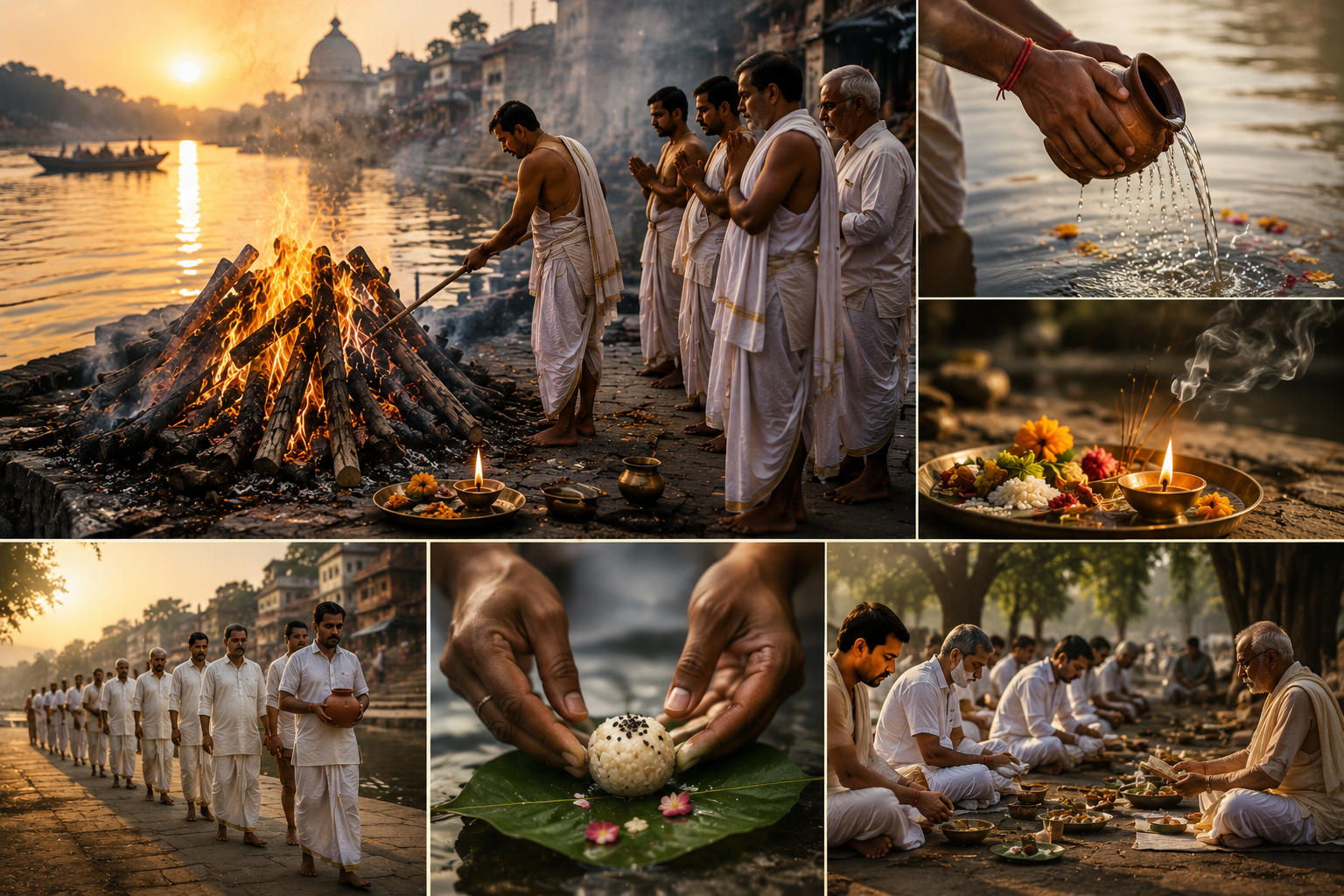
In Hindu traditions, death is not viewed as an end, but as a sacred transition of the soul from one state of existence to another. The rituals associated with death and the final rites — collectively known as Antyeshti or last rites — are deeply rooted in the concepts of karma, rebirth, purification, and liberation (moksha)
This article explores the meaning, symbolism, and sequence of Hindu last rites, along with the spiritual philosophy behind mourning rituals, ancestral offerings, and remembrance practices that continue even after death.
Phase 1: What to do at Home (Before the Final Journey)
1. When a Person is Dying (Impending Death)
- Purifying the Ground: When the prana (life breath) is in the throat, the person should not be left on a bed. The ground must be smeared with cow dung and earth, and Darbha (Kusha) grass and sesame seeds (Til) must be spread on it.
- Placing the Body: The dying person is placed on this purified bed of Darbha grass with their head pointing towards the South.
- Lighting the Lamp: A burning ghee lamp, referred to as a Chong, is placed near the head of the person, with its flame facing North.
- Items Placed in the Mouth: To purify the soul, drops of holy Ganga water or water from a Shaligram stone, along with Tulsi leaves, are placed in the mouth. A piece of gold or gem may also be placed in the mouth.
- Antdaan (Final Donations): While the person is conscious, they should be made to donate rice, clothes, and wealth (Antdaan) by holding sesame and water in their right hand.
2. Preparation of the Body (Post-Death)
- Bathing and Clothing: After death, the body is bathed with warm water. Sandalwood paste (Chandan) and fragrant substances are smeared on the body, and it is wrapped in a new, white 6-meter shroud (Kafan).
- General Preparation: Whether the deceased is a man or a woman, a bathing cloth must be tied. A tilak of Sindoor (vermilion) is specifically applied to the forehead using the Anamika (ring finger).
3. Building the Bamboo Arthi (Bier)
- Materials Required: The essential materials for constructing the arthi include two thick bamboo poles (about 8 feet long), eight smaller bamboo pieces (about 3 feet long), straw or hay, 500 grams of twine, a 6-meter shroud (Kafan), 16 flower garlands, and prepared sandalwood paste.
- Assembly: When these materials arrive at the house, two individuals should take charge of assembling the bier. The bier or wooden board should be washed thoroughly before use.
- Securing the Body: The assembled bier is brought inside, and the deceased’s body is carefully placed upon it. The body is covered with a cloth, such as a Ram Ram shawl, and is secured neatly and firmly to the bier using the twine so it remains stable during the final journey. Finally, the flower garlands are arranged over the body.
4. Special Rules for Children (Under 10 Years)
- Fetuses and Unteethed Infants: If a fetus is lost, no specific rites are performed. For an infant who dies before teething (a Shishu), the family should donate milk in their name.
- Up to 3 Years (Before Tonsure/Mundan): For a young child (Baalak) who dies before their head-shaving ceremony (around 3 years of age), the family should donate a water-filled pot and feed Kheer (sweet rice pudding) to others.
- Between 3 to 5 Years (Kumar): If a child of this age passes away, boys of the same age should be fed.
- Burial vs. Cremation: The texts specify that a child who dies before the age of 27 months should generally be buried in the ground rather than cremated, unless the death occurs on the banks of the holy river Ganga, in which case the body can be immersed in the water.
- Children Above 5 Years (Pauganda Stage): If a boy over five years of age dies (whether he has had his sacred thread ceremony or not), 10 Pindas made of Payas (milk and rice) and jaggery should be offered.
- Post-Cremation Rites for Older Children: For a child in this age group, the major rituals like the Vrishotsarga (releasing of the sacred bull) and Mahadaan (great donations) are skipped. The family only performs the 11th and 12th-day rituals. Crucially, if the father is still alive, the 12th-day Sapindikaran (the ritual that merges the soul with the ancestors) is not performed; instead, only a simpler Ekoddishta Shraddha is done on the 12th day.
5. Rites for a Married Woman (Suhagaan / Sati / Pregnant)
- For a Suhagan: While the sacred texts group the rites for women under a shared category, they mandate very precise, distinct rituals that must be performed specifically for a married woman (Suhagaan) during the preparation of her body:
- Application of Sindoor: After the body is bathed, a bathing cloth (snanpat) must be tied around the deceased. Specifically for a woman, a sacred tilak of *Sindoor (vermilion)—the ultimate mark of a *Suhagaan—must be applied to her forehead. The texts explicitly instruct that this Sindoor must be applied using the Anamika (ring finger)
- A Specific Shroud Mantra: Generally, when the shroud (Kafan) or head-cover (Kantop) is prepared by the tailor, the Gayatri mantra is written on it in reverse using saffron. However, the texts explicitly dictate a different rule for women: if a woman passes away, the Gayatri mantra is not used. Instead, a specific alternative mantra is written in reverse on her shroud – “Om Yat Dviyam Sarbhamhiya” (ॐ यत द्वि्यं सर्भंहिया)
- Removal of Old Threads: During the body’s preparation, if the woman was wearing any old sacred threads (Yajnopavit), they must be removed
- If a Pregnant Woman Dies: If a woman dies while full-term pregnant, the texts dictate a sensitive procedure: her womb must be carefully cut open to remove the child. The infant (if deceased) is buried in the earth, and only the woman’s body is cremated on the pyre.
- The Rite of Sati: If a devoted wife chooses to ascend the pyre with her deceased husband, she must first bathe, adorn herself with Kumkum, collyrium (Kajal), beautiful clothes, and ornaments. She distributes donations to Brahmins and relatives, bows to her elders, visits a temple to pray to Lord Vishnu, leaves her jewelry there, and finally, holding a coconut, takes her place on the flower-bedecked pyre holding her husband.
Phase 2: The Final Procession (Shav Yatra)
1. Who Can Give a Shoulder
In Hindu custom, this responsibility is typically reserved for male relatives, close family, or dear friends. However, the most important qualification is willingness and devotion. In modern times, women are also seen giving shoulders, especially when no male heir is present. According to the Garuda Purana, certain individuals should refrain: those observing a period of mourning for a recent death in their own family, Brahmacharis (celibate students), individuals with unshaven heads or unclean clothes, and anyone who has recently touched a deceased person before completing their own funeral rites.
2. Number of Bearers and How to Carry
Typically, four individuals are needed to carry the Arthi. The common belief about an odd number of bearers (3 or 5) bringing bad luck stems from the existence of such a period (Panchak Nakshatra). The procedure is to place the bamboo bier on the right shoulder (Apasavya). The Arthi should be carried with the deceased’s feet facing forward, allowing them to symbolically walk away from home without looking back.
3. Pind Daan: The Midway Offering
- The Significance: This is the first Pind Daan, also called Pratyahara Pind Daan. The offering helps to unite the departed soul with its ancestors.
- The Ritual: The pinds are offered when the procession reaches a significant spot, often a three-way intersection. The eldest son or chief mourner offers them while facing southward, reciting mantras. The place is then purified by sprinkling water.
- Pret Shila: The head of the deceased is ritually touched to the Pret Shila for souls who had an untimely death (Akal Mrityu) or took Sanyas.
Phase 3: In the Cremation Ground (Shmashan-Sthali)
1. Arriving and Preparing the Pyre
- The Sacred Pyre (Vedi): The Arthi is placed on a purified spot. A pyre is built using wood like Sandalwood, Palash, and Peepal. The body is placed on the pyre with the head facing North and feet facing South.
- Positioning: Head-side forward. The trunk is heavier; the front bearers will naturally be more careful.
- Alignment: When fire contracts the leg muscles, the body tends to slide backward. A higher head position and heavy logs on the chest prevent this and ensure proper burning.
2. The Cremation Rituals (Antyeshti)
- Lighting the Fire: A ghee lamp is ignited. Camphor is placed in a spoon tied to a bamboo stick, lit, and used to ignite the pyre from all four directions, starting from the head down to the feet.
- Vedic Mantras & Oblations: The lead mourner offers 116 oblations of the scented ghee into the fire while chanting specific Vedic mantras.
- Kapal Kriya (Breaking the Skull): When the body is half-burnt or nearly burnt, the skull is broken. For a householder, this is done using a piece of wood, and for an ascetic (Yati), it is broken using a Shreephal (coconut).
3. The Exception of Panchak / Tripad
Panchak refers to the specific astrological period governed by the five nakshatras starting from the second half of Dhanishtha up to Revati.
Normally, Hindu last rites dictate that a body should be cremated as soon as possible. However, the exception to this rule occurs if a person passes away during a specific set of inauspicious astrological constellations known as Panchak or Tripad.
If death occurs during this window, you cannot perform a standard cremation. Doing so is believed to prevent the soul from attaining salvation (Sadgati) and invites a curse or severe misfortune, potentially causing harm or another death among the family members, sons, or relatives.
What are the Panchak Nakshatras? – Panchak refers to a group of five specific constellations. According to the texts, this period starts from the second half (3rd and 4th Charana) of the Dhanishtha nakshatra and continues up to Revati
. The five constellations are:
- Dhanishtha (latter half)
- Shatabhisha
- Purva Bhadrapada
- Uttara Bhadrapada
- Revati
What are the Tripad Nakshatras? – Tripad refers to another specific grouping of constellations that carry a similar restrictive warning. These include:
- Krittika
- Punarvasu
- Uttara Phalguni
- Vishakha
- Uttarashadha
- Purva Bhadrapada
The Remedy (Panchak Shanti) Because you cannot perform a normal cremation during this excepted time, a special pacification ritual (Shanti) must be attached to the cremation process to neutralize the negative cosmic effects.
The Procedure: Four effigies (Puttalas) made of sacred Kusha grass are created and placed near the deceased’s body.
The Ritual: These effigies are consecrated by chanting specific Nakshatra mantras. They are then touched with heated gold, and a Homa (fire ritual) is performed.
The Cremation: Finally, the body is cremated along with these four grass effigies.
By performing this specific Shanti ritual, the astrological defect is pacified, and the deceased can safely attain the highest spiritual state without bringing harm to the surviving family.
Phase 4: After Coming Home
1. Ritual Purity and Disposal
- No Looking Back: It is strictly forbidden to look back at the funeral pyre.
- Asma Stone: After the cremation and before re-entering the home, each person touches a stone with their right foot. Traditionally, they would also touch fire, water, and a stone (e.g., an iron object or a piece of neem).
2. Shanti Karma (Vishesh Homa)
- Arya Samaj Perspective: To officially end the impurity period (Sutak), a special pacification fire ritual (Vishesh Homa) is performed in the house using fragrant herbs to destroy germs and odors.
Phase 5: Rituals for the Next 13 Days
1. 3rd Day – Asthi Sanchayan (Ash Collection)
- Cooling the Pyre: The site is first sprinkled with milk, and then with water.
- Washing the Bones: Bones are washed with a mixture of milk and water on Palash leaves.
- Soothing the Fire’s Pain: The earthen pot is carried fifteen steps to the north and placed in a pit. A Pinda is offered over this pot specifically to destroy and soothe pain from the fire.
- Final Immersion in the Ganga: The Garuda Purana declares that if the bones are immersed in the Ganga within ten days, the soul ascends to the highest Brahma Loka.
2. 1st to 10th Day (The 10 Pindas & Mundan)
- Building the Subtle Body: A Pinda is offered every day for 10 days. The 1st day’s Pinda forms the head, continuing until the 10th day when the body develops hunger and thirst.
- The 10th Day: The family shaves their heads (Mundan) to shed their grief.
3. 11th, 12th, and 13th Day
- 11th Day (Vrishotsarga): A sacred bull is branded with a Trishul and a Chakra and released.
- 12th Day (Sapindikaran): Using a small golden wire (Swarna Shalaka), the Pinda representing the deceased is divided into three equal parts and merged with the Pindas of the ancestors.
- 13th Day (Shayya & Pada Daan):
- Shayya Daan: A decorated bed with a golden idol of Lakshmi-Narayana is donated.
- Pada Daan: 13 specific items are donated: umbrella, shoes, clothes, ring, water pot, asana, five vessels, walking stick, copper vessel, raw grains, cooked food, arghya vessel, and sacred thread.
4. Ashta Maha Daan (Eight Great Donations)
- Sesame Seeds (Tila): Created from Lord Vishnu’s sweat; destroys sins.
- Iron (Loha): Keeps the soul away from Yama’s borders.
- Gold (Hiranya/Swarna): Guarantees the soul ascends to heaven.
- Cotton (Karpasa): Frees the soul from fear of Yama’s messengers.
- Salt (Lavana): Removes fear of Yama.
- Seven Grains (Saptadhanya): While variations exist, the seven grains often used include:
- Wheat (Gehun/Godhuma): Symbolizes stability and staple food.
- Barley (Jau/Yava): Widely used in Havan (fire rituals).
- Black Gram (Udid/Urad): Associated with spiritual energy.
- Green Gram (Moong): Symbolizes purity.
- Chickpeas (Chana): Represent prosperity.
- Sesame Seeds (Til): Used for removing negativity and in ancestor rituals.
- Rice (Dhan) or Millet (Bajra/Sorghum): Represents abundance
Rules of Impurity (Sutak / Ashauch)
According to the provided texts, here is the detailed breakdown of the Rules of Impurity (Sutak / Ashauch), encompassing both the traditional timelines and the prohibited activities.
1. Traditional Timelines (According to the Garuda Purana)
The period of impurity varies based on caste (Varna), the degree of biological relationship (Generations), and the timing of receiving the news.
A. Duration by Varna
The time required for a family to become “pure” again depends on their Varna:
- Brahmins: 10 days
- Kshatriyas: 12 days
- Vaishyas: 15 days
- Shudras: 1 month (30 days)
B. Duration by Relationship (Generations)
For the closest relatives, known as Sapindas, the standard period is 10 days. As the bloodline relationship becomes more distant, the duration of Sutak decreases:
- 4th generation: 10 nights
- 5th generation: 6 nights
- 6th generation: 4 days
- 7th generation: 3 days (these relatives are referred to as Sakulyas)
- 8th generation: 1 day
- 9th generation: 2 Prahars (approximately 6 hours)
- 10th generation (Gotrajas): Purified immediately simply by taking a ritual bath.
C. Hearing the News Late
- Within 10 days: If a relative lives far away and hears the news within the initial 10-day window, they observe the impurity only for the remaining days of that 10-day count.
- After 10 days but within a year: They must observe Sutak for 3 nights.
- After a full year: They are purified simply by taking a bath.
2. Prohibited Activities during Sutak
During this period, the family is considered ritually impure, and the following spiritual and social activities are strictly forbidden:
- Daily Prayers: Performing Sandhya or regular worship.
- Charity & Rituals: Giving Daan (charity), performing Japa (chanting), or Homa (fire rituals).
- Scriptural Study: The study of scriptures (Svadhyaya).
- Ancestral Offerings: Offering water to ancestors (Pitri-tarpana).
- Social/Religious Obligations: Feeding Brahmins or observing religious fasts (Vratas).
- Suspension of Duties: Everyday religious duties and auspicious ceremonies in the household remain suspended until the Sapindikaran (12th-day rite) is completed.
3. Exemptions from Sutak
The texts specify that certain individuals are “ever-pure” and do not incur the impurity of Sutak:
- Sanyasis (Yatis): Those who have renounced the world.
- Brahmacharis: Celibate students.
- Agnihotri Brahmins: Those who continuously maintain the sacred Vedic fire.
- Devotees: Those fully devoted to Brahman.
- Kings: Rulers and those in high administrative authority.
Shanka-Samadhan (Questions & Answers)
- Q: Is Antyeshti a true ‘Sanskar’?
- A: Yes, the 16th Sanskar. It purifies only the body.
- Q: Should we change the “Pind” direction halfway to the cremation ground?
- A: Yes.
- Q: Should we chant “Ram Naam Satya Hai”?
- A: Yes, for informing others and reminding oneself of the soul’s eternity. Suggested: “Atma hi Nityam hai, yeh Deh Anityam hai.”
- Q: Which side of the bier goes forward?
- A: Head-side forward.
- Q: Why keep the head slightly higher?
- A: To prevent the body from sliding backward and ensure proper burning.
- Q: Is electric cremation allowed?
- A: Yes. Cover the body with ghee-mixed fragrant samagri beforehand and chant mantras outside.